Table of Contents
The next generation fighter jet represents a major step forward in military aviation. Designed to meet future air-combat challenges, these advanced aircraft are expected to combine stealth technology, artificial intelligence, powerful sensors, long-range performance, and the ability to work with unmanned aircraft. next generation fighter jet Governments are investing in next-generation fighters to strengthen air superiority and prepare their air forces for increasingly complex threats.
Several programs are now shaping the future of combat aviation, including the United States’ F-47, the U.S. Navy’s F/A-XX, and the international Global Combat Air Programme (GCAP). Although many technical details remain classified, these projects offer a glimpse of how fighter jets may operate in the coming decades.
What Is a Next Generation Fighter Jet?
A next generation fighter jet is an advanced military aircraft developed to provide capabilities beyond those of many current fourth- and fifth-generation fighters. The term is commonly associated with sixth-generation combat aircraft, which are being designed for highly connected, data-driven operations.
Rather than relying on speed or maneuverability alone, these aircraft are expected to combine several capabilities into one integrated system. Their effectiveness may depend on how well they gather information, communicate with other platforms, avoid detection, and coordinate missions.
Next-generation fighters will likely operate alongside existing aircraft, satellites, ground-based systems, and autonomous drones. This approach allows military forces to share information across a wider network instead of depending on a single aircraft to perform every task.
Key Features of Future Fighter Jets
Advanced Stealth Technology
Stealth remains a central feature of future combat aircraft. Designers aim to reduce radar signatures and manage other detectable emissions, making it harder for opposing forces to locate, track, and engage an aircraft.
Future designs may combine carefully shaped airframes, specialized materials, and improved management of heat and electronic emissions. However, stealth does not make an aircraft completely invisible. Detection depends on the sensors, operating conditions, and tactics involved.
Artificial Intelligence and Sensor Fusion
Modern combat aircraft gather information from radar, electronic warfare equipment, cameras, and other sensors. Sensor fusion combines these sources into a clearer operational picture.
Artificial intelligence may help crews process large amounts of information, identify potential threats, and prioritize tasks. These tools can support decision-making, but their actual roles will depend on testing, reliability, and operational requirements.
Teaming With Uncrewed Aircraft
One of the most important developments is the use of crewed fighters alongside uncrewed combat aircraft. Often described as collaborative combat aircraft, these drones may support surveillance, electronic warfare, decoy operations, or other missions.
A crewed fighter could coordinate several uncrewed platforms, allowing them to operate at different distances or carry out complementary tasks. The exact level of autonomy and human control will vary by program.
Longer Range and Improved Performance
Future fighters may need to operate across large distances, particularly in regions where air bases are far from potential areas of conflict. Greater range could reduce dependence on aerial refueling and provide more flexibility during missions.
Engine efficiency, weapons integration, thermal management, and aerodynamic design will all influence performance. Specific speed, range, and payload figures are not publicly confirmed for many aircraft still under development.
Secure Communications and Electronic Warfare
Future air combat will depend heavily on secure data links and the ability to operate when communications or navigation systems are disrupted. Next-generation aircraft are expected to place significant emphasis on electronic warfare, resilient networking, and rapid information sharing.
These features could help pilots understand threats and coordinate with other platforms in contested environments.
Major Next Generation Fighter Jet Programs
1. F-47: The U.S. Air Force’s Future Fighter
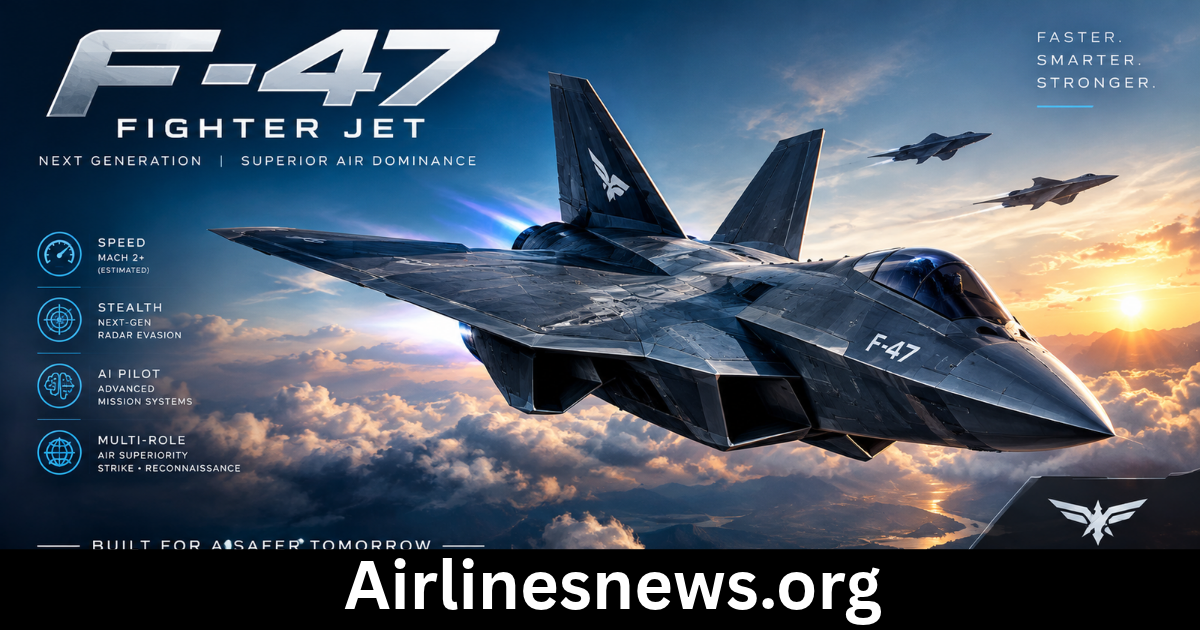
The F-47 is the United States Air Force’s next-generation air-superiority fighter being developed by Boeing under the Next Generation Air Dominance initiative. It is intended to succeed the F-22 Raptor as the service’s leading air-superiority aircraft.
In October 2026, the Air Force continued preparations for the program, including plans for specialized testing facilities at Nellis Air Force Base. The first flight remains targeted for 2028, although development schedules can change as testing progresses. The Air Force has discussed acquiring at least 185 aircraft. These plans indicate the scale of the effort, but the final fleet and delivery timeline will depend on future decisions and program performance. Source: Air & Space Forces Magazine
The F-47 is expected to emphasize stealth, advanced mission systems, extended range, and coordination with collaborative combat aircraft. Detailed specifications remain classified, so many claims about its exact capabilities should be treated cautiously.
2. F/A-XX: The U.S. Navy’s Future Carrier Fighter
The F/A-XX is being developed for the U.S. Navy to operate from aircraft carriers. In September 2026, Boeing was selected for the program under a multibillion-dollar contract.
The aircraft is intended to augment and eventually replace older F/A-18E/F Super Hornets and EA-18G Growlers as the Navy modernizes its carrier air wings. It is expected to operate alongside the F-35C and support uncrewed aircraft. Source: Air & Space Forces Magazine
Carrier operations create distinct engineering challenges. A naval fighter must be suitable for demanding takeoffs and landings, fit within carrier operating constraints, and support long-range missions over water. Public information about the F/A-XX’s detailed design and performance remains limited.
3. Global Combat Air Programme (GCAP)
The Global Combat Air Programme is a partnership between the United Kingdom, Italy, and Japan to develop a next-generation combat aircraft. The program aims to deliver an advanced fighter for service around 2035.
In July 2026, the partner nations awarded a £4.6 billion contract to advance the aircraft’s design and development. The program is expected to incorporate advanced sensors, digital engineering, propulsion technology, and cooperation with autonomous systems. Source: UK Government
GCAP is also an industrial partnership. Sharing development responsibilities and costs may help the participating countries maintain their aerospace expertise while creating a common aircraft for future operations.
4. Future European Combat Aircraft
European countries have also explored next-generation combat-air systems. These efforts involve more than building a new fighter: they may include uncrewed aircraft, secure communications, shared data networks, and supporting digital infrastructure.
The future of these projects depends on political agreements, funding, industrial cooperation, and the ability to settle requirements among participating countries. Their timelines and final configurations may evolve as negotiations and development work continue.
How Next Generation Fighter Jets Differ From Current Aircraft
Fifth-generation fighters such as the F-22 and F-35 already combine stealth, advanced sensors, and networked operations. The next generation is expected to build on these foundations rather than replace them with one entirely new feature.
Potential differences include deeper integration with uncrewed aircraft, more adaptable mission systems, improved electronic warfare, and greater ability to share information across a combat network. The goal is to make the entire force more effective, not simply to produce a faster aircraft.
Actual performance comparisons will remain difficult until new fighters complete testing and enter operational service. Publicly available concept images and preliminary announcements do not provide enough information to verify every claimed advantage.
Challenges in Developing Future Fighter Jets
Developing a next-generation fighter is a complex and expensive undertaking. Stealth design, advanced propulsion, software, sensors, and weapons must work together reliably under demanding conditions.
Programs can face cost increases, technical delays, supply-chain difficulties, and disagreements over requirements. International projects must also coordinate work among governments and companies with different industrial priorities.
Testing is particularly important because an aircraft must demonstrate that its systems work safely and consistently, not merely perform well in a simulation or concept presentation. Operational readiness may take years after the first flight.
Why Next Generation Fighter Jets Matter
Future fighters could help air forces monitor larger areas, respond to emerging threats, and coordinate operations with a broader range of platforms. Their value will depend on the aircraft itself as well as training, maintenance, weapons, communications, and support infrastructure.
These programs also influence national aerospace industries. Developing advanced aircraft can support engineering jobs, manufacturing capabilities, and research in areas such as computing, materials, propulsion, and robotics.
Nevertheless, advanced technology alone does not guarantee success. Training, sound planning, dependable logistics, and effective integration with other military systems remain essential.
Frequently Asked Questions
1. What is the next generation fighter jet?
It generally refers to an advanced future combat aircraft, often described as sixth generation, designed to improve stealth, sensing, connectivity, electronic warfare, and cooperation with uncrewed systems.
2. What is the F-47 fighter jet?
The F-47 is Boeing’s next-generation air-superiority fighter under development for the U.S. Air Force. It is intended to succeed the F-22 Raptor, with its first flight targeted for 2028.
3. What is the difference between the F-47 and F/A-XX?
The F-47 is being developed for the U.S. Air Force, while the F/A-XX is intended for the U.S. Navy’s carrier-based operations. Their designs must meet different service requirements.
4. Which countries are developing a next generation fighter jet?
The United States is developing the F-47 and F/A-XX. The United Kingdom, Italy, and Japan are working together on GCAP, while other countries are pursuing or evaluating their own future combat-air initiatives.
5. Will next-generation fighter jets use artificial intelligence?
AI is expected to support tasks such as processing sensor information, helping prioritize threats, and coordinating with uncrewed aircraft. The precise functions and level of human oversight will differ across programs.
6. When will next-generation fighter jets enter service?
Timelines vary. The F-47 is targeting a first flight in 2028, while GCAP aims for service around 2035. First flight is not the same as operational service, which generally requires additional testing and evaluation.
7. Are next-generation fighter jets invisible to radar?
No aircraft is completely invisible to every radar or sensor. Stealth technology aims to reduce detectability and make tracking and engagement more difficult, but effectiveness depends on many factors.
Conclusion
The next generation fighter jet is set to shape the future of military aviation through advanced stealth, improved sensors, secure communications, electronic warfare, and cooperation with uncrewed aircraft. Programs such as the F-47, F/A-XX, and GCAP show how countries are preparing for more connected and demanding air operations. next generation fighter jet Although many technical details remain classified and schedules may change, these projects represent significant investments in future airpower. Their long-term success will depend on reliable technology, realistic testing, manageable costs, and effective integration with the wider military force. For readers following aviation news, these developments will remain important indicators of where combat aircraft design is heading.
Related Posts

AirlinesNews TR-3B: Exploring Aviation News, Travel Updates, and Advanced Aircraft Technology
Understanding AirlinesNews TR-3BThe Importance of Aviation NewsAirline Industry DevelopmentsAviation Safety…

F 47 Fighter Jet: Powerful Features of America’s Sixth-Generation Stealth Aircraft
What Is the F 47 Fighter Jet?Why Is the United…
F47 Fighter Jet: 7 Powerful Facts About America’s Sixth-Generation Stealth Aircraft
1. What Is the F47 Fighter Jet?2. Why Is the…