Table of Contents
Stealth fighter aircraft are among the most advanced military jets ever developed. Designed to reduce their visibility to enemy detection systems, these aircraft combine specialized shapes, radar-absorbing materials, advanced sensors, stealth fighter aircraft and powerful engines. Their purpose is not simply to fly fast but to operate more effectively in heavily defended airspace.
Aircraft such as the F-22 Raptor, F-35 Lightning II, China’s J-20, and Russia’s Su-57 demonstrate how stealth technology is changing modern military aviation. As more countries invest in next-generation fighters, stealth aircraft are becoming an increasingly important part of air-power development.
What Is a Stealth Fighter Aircraft?
A stealth fighter aircraft is a military jet designed to reduce the chances of being detected, tracked, and targeted by enemy radar and other sensors.
Traditional fighter jets can be detected by radar because their surfaces reflect electromagnetic energy. Stealth fighters use carefully designed airframes and specialized materials to reduce the amount of radar energy reflected toward its source.
However, stealth does not make an aircraft completely invisible. It makes detection and tracking more difficult, depending on the radar system, viewing angle, distance, and operating conditions.
Modern stealth fighters also use advanced electronic systems to manage their electromagnetic and infrared signatures.
How Does Stealth Technology Work?
Stealth technology combines several engineering features to reduce an aircraft’s overall signature.
Radar-Reducing Aircraft Design
The shape of a stealth fighter is carefully designed to redirect incoming radar energy away from the radar receiver. Angled surfaces, aligned edges, and carefully shaped wings help reduce radar reflections.
Radar-Absorbing Materials
Special coatings and composite materials can absorb some incoming radar energy rather than reflecting it. These materials support the aircraft’s low-observable design, although they require careful maintenance.
Internal Weapons Bays
Many stealth fighters carry their primary weapons inside internal compartments. This helps preserve their carefully designed external shape.
Carrying weapons externally can increase an aircraft’s radar signature, so internal carriage is important when low observability is a priority.
Engine and Heat Management
Jet engines generate heat that can be detected by infrared sensors. Stealth aircraft may use design features to manage engine visibility and reduce thermal signatures.
Advanced Sensors and Electronics
Stealth fighters are not defined by their external shape alone. Modern examples use advanced radar, electronic warfare systems, communications equipment, and sensor fusion to improve situational awareness.
Famous Stealth Fighter Aircraft in the World
Several countries operate or are developing aircraft with stealth characteristics. Their designs and operational capabilities differ considerably.
1. F-22 Raptor
<escape> </escape>The <escape> </escape><Entity value=”F-22 Raptor” category=”vehicle” disambig=”United States stealth air-superiority fighter aircraft”/> is an American fifth-generation fighter developed by Lockheed Martin and Boeing. It was designed primarily for air superiority, giving it a combination of stealth, speed, maneuverability, and advanced avionics.
The F-22 features supercruise, allowing it to fly supersonically without continuously using afterburners. It also uses internal weapons bays and advanced sensors.
The aircraft remains one of the most prominent examples of dedicated stealth air-superiority fighters. <Cite refs={[“turn910837search3″,”turn910837search1”]}/>
2. F-35 Lightning II
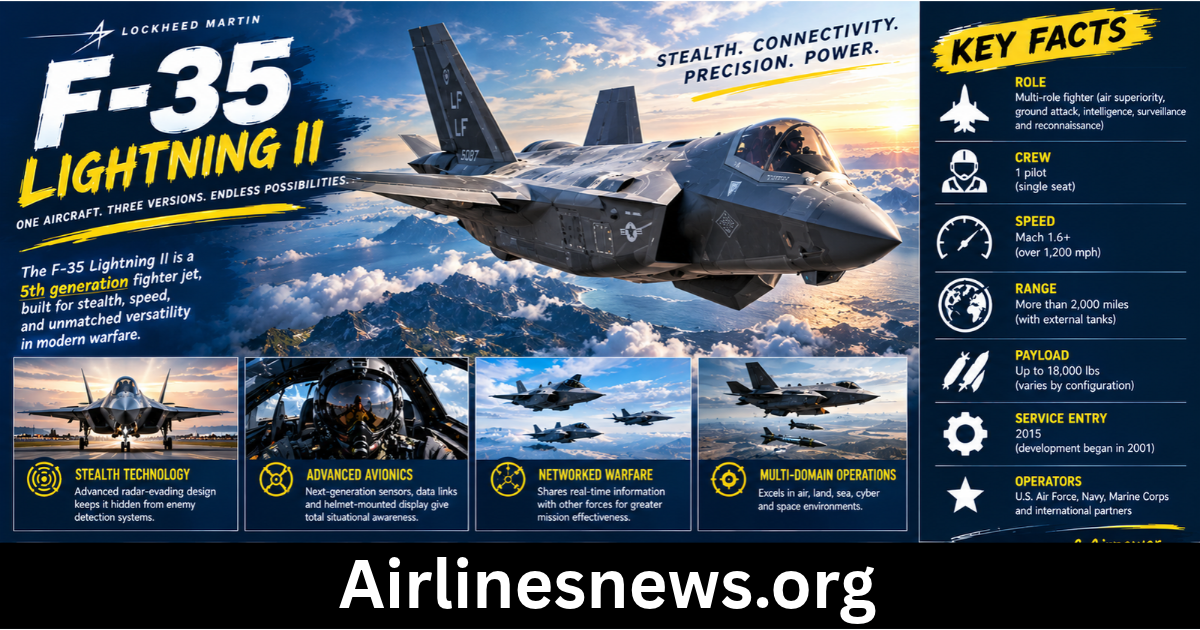
The <Entity value=”F-35 Lightning II” category=”vehicle” disambig=”United States fifth-generation multirole stealth fighter aircraft”/> is a family of stealth fighters developed for the United States and partner nations.
It comes in three main versions:
- F-35A: Conventional takeoff and landing.
- F-35B: Short takeoff and vertical landing.
- F-35C: Designed for aircraft carrier operations.
Unlike the F-22, which focuses primarily on air superiority, the F-35 is designed for a broad range of missions, including air-to-air combat, strike operations, and intelligence gathering. Its advanced sensors and information-sharing capabilities are major parts of its design. <Cite refs={[“turn910837search12″,”turn910837search0”]}/>
3. Chengdu J-20
China’s <Entity value=”Chengdu J-20″ category=”vehicle” disambig=”Chinese fifth-generation stealth fighter aircraft”/> is a long-range stealth fighter developed by Chengdu Aerospace Corporation.
The J-20 is designed to support China’s air-combat requirements and features a distinctive airframe, internal weapons bays, and advanced avionics.
It entered service with the Chinese military in 2017. Publicly available information about its full performance and operational capabilities remains limited.
4. Sukhoi Su-57
Russia’s <Entity value=”Sukhoi Su-57″ category=”vehicle” disambig=”Russian fifth-generation multirole stealth fighter aircraft”/> is a fifth-generation fighter developed by Sukhoi.
It combines reduced-observability design features with advanced flight controls, maneuverability, and multirole capabilities. The aircraft is intended for both air-to-air and air-to-ground missions.
Its development has involved technical and production challenges, and assessments of its stealth performance vary. It should not automatically be assumed to have the same low-observable characteristics as every other fifth-generation fighter.
5. F-117 Nighthawk
The <Entity value=”F-117 Nighthawk” category=”vehicle” disambig=”Retired American stealth attack aircraft”/> was one of the first operational aircraft designed around advanced stealth principles.
Although frequently called a stealth fighter, it was primarily a precision attack aircraft rather than a conventional air-superiority fighter. Its angular shape helped reduce radar reflections, making it an important milestone in stealth aviation.
The F-117 was officially retired from regular U.S. Air Force service in 2008, although limited flying activity has continued for testing and training purposes.
What Makes Fifth-Generation Fighter Jets Special?
Fifth-generation fighter aircraft combine stealth with advanced digital systems and high-performance flight characteristics.
Their main features commonly include:
- Low-observable airframe design.
- Advanced radar and electronic warfare equipment.
- Internal weapons storage.
- Integrated sensors and information sharing.
- Sophisticated flight-control systems.
- High-performance engines.
Not every aircraft has identical capabilities. For example, the F-22 and F-35 have different mission priorities, while the J-20 and Su-57 follow their own national design approaches.
Advantages of Stealth Fighter Aircraft
Reduced Radar Detection
Stealth technology can make it more difficult for enemy radar systems to detect and track an aircraft, particularly under conditions for which its design is optimized.
Improved Mission Flexibility
Stealth fighters can perform different missions, including air defense, escort, surveillance, and precision strike operations, depending on their configuration.
Advanced Situational Awareness
Modern sensors help pilots collect and combine information from multiple sources. This can improve their understanding of the surrounding airspace.
Greater Survivability in Contested Airspace
Reduced observability, electronic warfare, and advanced mission systems can improve an aircraft’s chances of operating in areas protected by sophisticated air defenses.
Limitations of Stealth Fighter Jets
Stealth aircraft also have important disadvantages. Their development and purchase are expensive, and specialized coatings and components may require additional maintenance.
Their internal weapons capacity can be more limited than the external payload carried by some conventional fighters. Carrying weapons externally may increase radar visibility.
Stealth is also not a guarantee against detection. Different radar frequencies, infrared sensors, passive detection systems, and integrated air defenses can create challenges for low-observable aircraft.
The Future of Stealth Fighter Aircraft
The next generation of stealth aviation is expected to focus on improved sensors, artificial intelligence-assisted systems, electronic warfare, and greater cooperation between crewed and uncrewed aircraft.
The United States is developing its Next Generation Air Dominance program, while other countries are pursuing their own future combat-aircraft projects. Examples include the Global Combat Air Programme involving the United Kingdom, Italy, and Japan, and the Future Combat Air System involving France, Germany, and Spain.
Future designs may place greater emphasis on network connectivity, long-range operations, advanced propulsion, and adaptability to changing air-defense technology.
Frequently Asked Questions About Stealth Fighter Aircraft
1. What is the main purpose of a stealth fighter aircraft?
Its main purpose is to reduce detection and tracking by enemy sensors, improving its ability to operate in defended airspace.
2. Which is the most famous stealth fighter aircraft?
The F-22 Raptor and F-35 Lightning II are among the world’s best-known operational stealth fighters. They were developed for different mission requirements.
3. Are stealth fighter jets invisible to radar?
No. Stealth aircraft are designed to reduce their radar signatures, not eliminate them completely. Detection depends on radar technology and operating conditions.
4. Which countries have stealth fighter aircraft?
The United States, China, and Russia operate stealth fighter designs. Several other countries are developing or participating in future combat-aircraft programs.
5. What is the difference between the F-22 and F-35?
The F-22 was designed mainly for air superiority, while the F-35 is a multirole aircraft developed for air combat, strike missions, and information gathering.
6. Can stealth fighter aircraft fly faster than sound?
Yes. Several stealth fighters are supersonic. The F-22 also has supercruise capability, while the F-35 can reach supersonic speeds for limited periods.
7. Are stealth fighter aircraft expensive?
Yes. Their advanced materials, engines, sensors, software, and maintenance requirements make them expensive to develop and operate.
Conclusion
Stealth fighter aircraft have transformed modern military aviation by combining reduced radar visibility with advanced sensors, powerful engines, and sophisticated mission systems. stealth fighter aircraft The F-22, F-35, J-20, and Su-57 represent different approaches to fifth-generation combat-aircraft development. Although stealth offers important advantages, it does not make an aircraft invisible or invulnerable. Future fighter programs will continue to develop low-observable technology alongside artificial intelligence, electronic warfare, and connected combat systems. These innovations will help shape the next chapter of military aviation.
Related Posts
F-35 Fighter Jet: Latest Aviation News, Stealth Technology, and Advanced Capabilities
IntroductionWhat Is the F-35 Fighter Jet?Latest F-35 Fighter Jet Aviation…
F47 Fighter Jet: 7 Powerful Facts About America’s Sixth-Generation Stealth Aircraft
1. What Is the F47 Fighter Jet?2. Why Is the…

Apache Helicopter: 1 Features, Speed, Weapons, Specifications, and History
What Is the Apache Helicopter?SpecificationsSpeed and Engine PowerWeapons and Defense…